

Join us for a day of physics workshops and keynote at the Norwich Festival of Physics on Friday 10th July, 9.30am – 3.30pm. Generously hosted by the University of East Anglia, this full day of training and workshops will include sessions for all secondary teachers of science, including ECTs and trainees. Technicians are also welcome. Lunch and refreshments are included, and you will leave with plenty of festival resources!
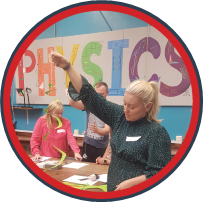
Sessions will include hands-on practical activities and ideas for making your teaching even more engaging, all delivered by expert physics teacher trainers. There will also be a chance to network with colleagues from across the region and browse exhibition stands showcasing nationally and locally available resources, as well as physics equipment and suppliers.
We are delighted to be welcoming Alan Denton as the keynote speaker and are looking forward to his engaging talk ‘Identifying hinge questions to help with key concepts.’
Booking for this event is now live and will close on Thursday 2nd July. Please make your workshop preferences when you book and we will do our best to accommodate your choices. Please find full programme details below, followed by the booking form.
Early Bird – discounted ticket £10 per person (available until 12th June 2026).
Standard ticket price £15 per person.
No charge for Initial Teacher Trainees.
Please note all ticket prices are subsidised by Physics Partners. There is the option to request an invoice upon booking. You may find this letter template useful for asking your school to pay the fee.
Checkout issues? Book here.Keynote Speaker: Alan Denton — Identifying hinge questions to support key conceptual understanding
This keynote begins by exploring the evidence for using tightly targeted, conceptual questions to reveal and strengthen student understanding. It then moves quickly into the practical essentials every science teacher needs: how and when to use hinge questions effectively in lessons, and where to find high-quality examples to support planning and classroom practice.
Workshop choices – attend three throughout the day.
| Improving representation across the physics curriculum | Ally Davies | KS3 – KS4 – KS5 | In this session, we’ll explore the importance of representation in building science capital and student identity. You’ll leave the session with links to free resources and with practical strategies that can be embedded across the physics (and science) curriculum. | Ally Davies taught physics in state schools in Cambridgeshire and Suffolk. For the last 20 years he has been providing free professional support for teachers of physics (for IOP, the Ogden Trust, Isaac Physics and Physics Partners). In his semi-retirement, he’s working on projects to develop maths skills in science and to improve inclusion and representation. He is a member of the ASE Teacher Developers’ Committee and serves his local IOP Branch. |
| Maths in GCSE Physics | Liz Nourshargh | KS4 | This session will explore the reasons why some students experience difficulties with maths in GCSE physics. It will introduce tried-and-tested approaches to supporting students with rearranging equations, using alternatives to the traditional “triangle” method, including proportional reasoning and balancing techniques. The session will also highlight resources that help students develop and practise their maths skills within a science context. | Dr Liz Nourshargh taught Physics for 18 years in schools across Buckinghamshire and Milton Keynes. After leading the local IOP Physics Teacher Network, she joined the IOP as a Professional Support Coach and now supports Physics education and teacher development for organisations including Cambridge OCR and the IOP. Liz joined Physics Partners in 2025 and is the Coach for Leighton Buzzard hub. Her interest in the maths content of GCSE Science led to work with Dr Caroline Neuberg and Ally Davies on research into trainee science teachers’ maths skills and confidence, published as The Elephant in the Science Staff Room in 2025. |
| Circuit Training | Eleanor Wylie | KS3 – KS4 | This session will explore tried-and-tested approaches to building a secure understanding of electric circuits at KS3, providing a strong foundation for KS4. We will look at effective models and practical activities that help address common misconceptions, alongside hands-on circuit work and strategies for teaching students how to troubleshoot during practicals. The session will also consider the role of language and curriculum sequencing in supporting students’ understanding. | Eleanor Wylie is a former Physics teacher who now works as a coach for Physics Partners and for other organisations supporting physics teaching. She is passionate about making physics accessible to all and supporting teachers to achieve this. |
| Save Planning and Marking Time with Isaac Science | Ingrid Murray and Cyrus Hafezparast | KS3 – KS4 – KS5 | Explore Teacher Account features and physics problem-solving using the Isaac Science online platform. Attendees will be given free samples of Isaac Science books. | Ingrid Murray is the Teacher Support Manager at Isaac Science. She has taught and led physics in British schools for over 20 years. She provides professional training for teachers which is accredited by the British Institute of Physics and runs events for teachers and students. She is a Fellow of the Royal Astronomical Society and an Associate of Newnham College, Cambridge. Cyrus Hafezparast is a Project Physicist for Isaac Science and supports the University of Cambridge STEM SMART programme, bringing years of teaching experience to the development and delivery of physics resources, events and online classes. Having previously held faculty leadership roles teaching Maths in schools serving low income communities in South London, Cyrus now sits on the Teach First Ambassador Council, advising on campaigns, strategy and the needs of ECTs and students from disadvantaged backgrounds. |
| Newton’s Laws in Sequence | Paul Hammond | KS3 – KS4 | This session will look at the fundamentals of Forces and Motion and suggest a sequences in which Newton’s Laws should be covered. What do we wish students to know by the end of Year 9 to give them a firm foundation for coverage to begin GCSEs ? When do we introduce calculations ? In the process of identifying this sequence we will identify the two most persistent student misconceptions and – with a wealth of eye-catching demonstrations, put forward ways in which they can be challenged and corrected. | Paul Hammond began his career as a Physics teacher in East London in 1985 and is now Director of Education at Physics Partners, as well as an active coach for The Ogden Trust in the Home Counties. Over the past four decades, Paul has been a successful Head of Science, worked at the National College for School Leadership developing the Leading from the Middle programme, and served as founding Deputy Headteacher and later Principal of Oasis Academy Enfield, where the academy achieved the Trust’s best GCSE and A-level results. Based in Luton, Paul is Chair of Governors at Chiltern Academy, facilitates NPQs, and coaches aspiring headteachers. A devoted season ticket holder at Tottenham Hotspur, it remains the only area of his life where he tolerates underachievement. |
| Hooke’s Law – getting the best at both KS3 and KS4 | Alan Denton | KS3 – KS4 | Investigating springs repeats in KS3 and KS4. In this session we’ll try to answer: – How can me make the experiment meaningful, effective and memorable? – What does a spring constant actually mean? – What is actual point of the experiment? – Where can we see significant progression between KS3 and KS4? | Alan Denton is the former Head of Science and Head of Physics at a large school in Bury St Edmunds. He now designs, writes, and leads teacher training courses used nationally and internationally, and works with teachers in a variety of roles for several of the UK’s leading physics education organisations. During his time as Head of Physics, his department significantly increased both uptake and attainment in physics. However, he is equally proud of persuading an Apache helicopter to land on the school field for a physics lesson. |
Programme
9:30 – 10:00 Registration, refreshments and exhibition stands
10.00 – 10.10 Welcome
10:20 – 11:20 Workshop session one
11:25 – 12:25 Workshop session two
12:30 – 13:20 Lunch and exhibition stands
13:30 – 14:30 Workshop session three
14:35 – 15:15 Keynote,
15:15 – 15:30 Raffle and close
Please contact info@physicspartners.com if you have any questions about your booking.
There will be exhibition stands available to browse from AQA, Data Harvest and Isaac Science. Information about The Ogden Trust will also be available along with Physics Partners.
THE FESTIVAL OF PHYSICS AT UNIVERSITY OF EAST ANGLIA IS SUPPORTED BY:


